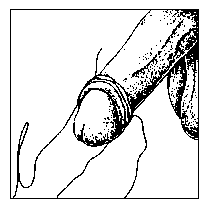
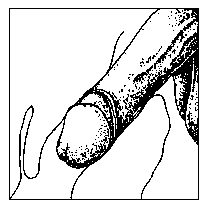
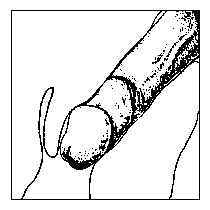
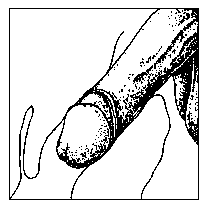
Intercourse with and without a foreskin.
 |
 |
 |
 |
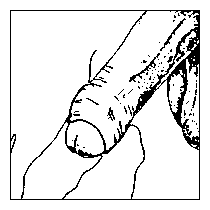 |
1. The foreskin is retracted before entry, or retracts on entry 2. At the start of the 'in' stroke the foreskin still bunches behind the glans 3. The corona is only fully exposed at maximum penetration 4. On the 'out' stroke the foreskin moves up to the corona 5. The skin bunches behind or rolls over the corona, killing sensation |
These sketches show was happens during intercourse when a foreskin is present. While the details will vary with the individual foreskin, it is clear that the foreskin reduces the potential level of sensation. Of course, this still permits successful attainment of orgasm and conception of children, but the full experience isn't there. Sensation is pretty much confined to the 'in' stroke.
Without a foreskin the corona (rim) of the glans is exposed on the 'out' stroke and receives good stimulation, greatly enhancing the experience of coitus. Does this mean premature ejaculation is more likely? It seems not. The causes of premature ejaculation are often psychological. With greater sensation the whole act becomes more enjoyable so it's in the interest of both partners to prolong it. At the same time there is no need for fast and hard thrusting. Greater sensation gives greater control; the man can respond to the woman's needs knowing that he can easily reach climax when he needs to.
Before you go all the way
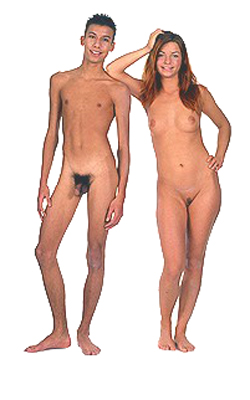
For many young people sex play - petting - will be important for quite a long time before 'going all the way' wth a partner. Does circumcision make a difference here? Well, first of all it will depend on what a girl is used to. If you have a circumcised penis in the USA, or an uncircumcised one in the UK, it will seem normal to the girl and if she has any previous experience she'll know how to handle it. Even if she's a complete novice, it won't surprise her.
Unfamiliarity can sometimes lead to awkward situations. An American woman encountered an uncircumcised man for the first time, pulled his foreskin back, and grabbed hold of his knob to play with it, as she would with a circumcised man. He yelped and called her an "insensitive bitch". The romance went no further and the woman wrote to a woman's magazine asking what she had done wrong. "How can I date a man when I can't even give him a hand job?" On the other side of the coin several circumcised men have complained that women just tug at it as if they are trying to pull it off. Clearly, you may need to educate your girlfriend in how to handle your penis.
So are there any overall preferences in this field? The roundhead look is clearly seen as more attractive to a majority of women. Uncircumcised penises need to be well washed or women will complain about the smell. On the other hand, many women (from both circumcising and non-circumcising countries) have said that it is much easier to masturbate a man with a foreskin. But a roundhead is strongly preferred for oral sex. More details can be found on our Surveys page.
The bottom line is that you will have to show your girlfriend how you like to be handled. (Just as she will need to educate you on how to handle her). And if you have a foreskin, make sure you keep it clean.
Picture courtesy of Bravo, the German teen magazine.
Masturbation
Will getting circumcised mean I have to change the way I masturbate? The answer is a definite 'maybe'.
Before we get into that, let's take a quick look at Western ideas about masturbation. Before Christ's time, there was nothing to suggest that masturbation was either sinful or harmful. (Onan's sin was not masturbation.) The ancient Egyptians believed that the Nile was constantly replenished by the masturbation of the god Osiris. The Greeks and Romans just saw it as something that boys did. Around 200 AD the Jewish people became very legalistic. This was the Rabbinical period, when the great Temple at Jerusalem had been destroyed, the population dispersed, and they felt a strong need to assert their cultural values. This led to a huge body of law codified through rabbinical debate. For some reason, masturbation was part of this, and many rabbis took this to the extent that a man should never touch his penis, even during urination, for fear that masturbation would result. The rationale leading to this was presumably that with the Jews dispersed and persecuted, every bit of semen was important for increasing the Jewish population.
By the Middle Ages the Christian churches had decided that sex was only for procreation and therefore masturbation was a sin. But confess, say three 'Hail Marys', and your sin was absolved. Among the general population it was just seen as something that boys did, and would grow out of when they got girls. The view that masturbation was a childish thing, and therefore trivial, persisted up until the end of the 17th century. From then on, the idea that masturbation was harmful gained ground, largely promulgated by snake-oil merchants offering supposed 'cures'.
One idea that gained currency at that time was that circumcision would make masturbation impossible. How this could be believed when, for 1,500 years, circumcised Jews had been cautioned against the evils of masturbation, is difficult to understand. But clearly those who promulgated this view (obviously masturbators themselves) masturbated by moving the foreskin over the sensitive glans (as do uncircumcised men today, if they have enough spare skin). If the foreskin could not be mobilised over the glans, so went their reasoning, masturbation wasn't possible. Doubtless then, as now, many men with short foreskins were also unable to do this, and just moved their loose skin on the penile shaft. But of course they couldn't stand up and say so or they would be admitting they masturbated.
This nonsense has led to the view, much promoted by intactivists, that the widespread adoption of circumcision at the end of the 19th century was intended to prevent masturbation. It wasn't, and only a few cranks (maybe vociferous ones) believed it. Circumcision was introduced because of its health and hygiene benefits.
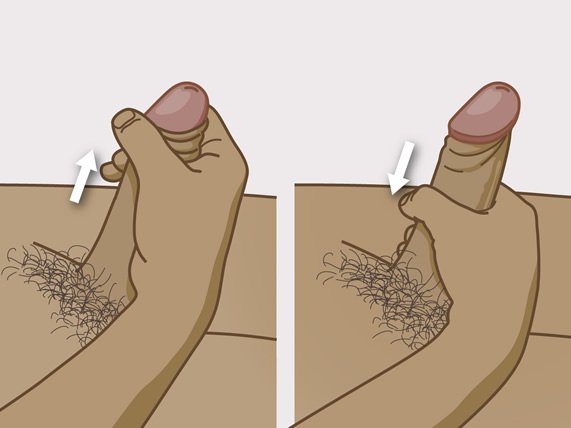
Uncircumcised masturbation - pumping the shaft skin.
Courtesy Zanzu, the German / Flemish sexual health site
So after this digression, what happens after you are circumcised? If you had previously masturbated by moving your foreskin over the glans, you will have to change what you do. Maybe you will move your skin on the shaft, as many uncircumcised and circumcised boys do. But many circumcised men (and some uncircumcised ones) masturbate with a lubricant (hand cream or massage oil) sliding their hand over the knob and shaft. Some just lightly stroke without a lubricant. One way or another you will still be able to masturbate and, according to most of the reports we receive, you'll find that direct contact with the glans is far more satisfactory than the alternatives.
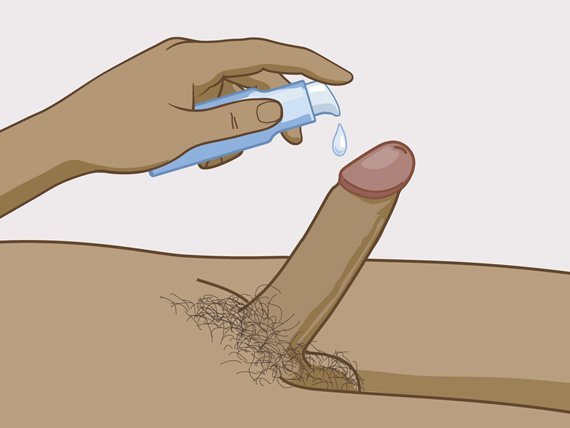
Circumcised masturbation using a lubricant.
Courtesy Zanzu, the German / Flemish sexual health site
A much fuller discussion of masturbation techniques is given on the aboutcirc site.
Many of the topics dealt with in this brief survey are covered in more detail elsewhere on this site, so do take time to browse around.
Copyright © 1992 - 2021, All Rights Reserved CIRCLIST.