Definition of Hypospadias
The normal male urethral opening is at the tip of the penis, centrally located with respect to the glans. A birth defect in which the urethral opening is on the underside of the penis instead of on the tip is called a hypospadias. By the standards of congenital defects generally it is quite common, reportedly occuring in 1 per 250 male births in the USA [Gatti et al., 2007], 1 per 300 male births in New Zealand [Kuschel and Hamill, 2005]. There appears to be a plurality of possible causes; genetic, endocrine and environmental. There is some evidence to suggest that the incidence of hypospadias is rising, possibly due to the increasing presence in the environment of chemicals that mimic female hormones. This supports the belief that hypospadias should be regarded as a minor intersex condition, signifying incomplete transition of the external genitalia in utero from the default female state to the male state expected in the presence of a Y-chromosome. The foreskin is typically incomplete, forming a hood over the dorsal part of the glans.
Variations in the position of the meatus
The severity of the defect can vary widely. As the following diagram illustrates, the urethral opening may be located anywhere from the glans (mild) to the perineum (severe) and the defect is classified accordingly. However, 90% of cases have the meatus on or just below the glans - severe cases are much rarer.
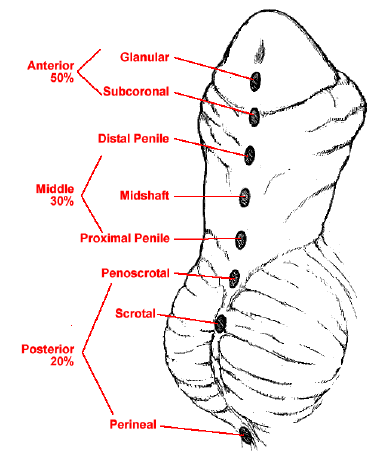
Image © 2005, Auckland District Health Board [NZ]
Urination prior to repair of hypospadias
 Hypospadias results in discharge of urine from the mislocated urinary meatus. In adolescence and adulthood semen will emerge in the same place. The condition is distressing both for children and adults and merits priority attention. It is not merely a cosmetic matter. Deep psychological issues are involved and fertility can also be affected on account of a reduced ability to deposit semen in close proximity to the woman’s cervix.
The absolute necessity of operative intervention depends on the severity of the condition. In most countries anything other than glandular hypospadias would be a candidate for operation. Surgical repair of hypospadias is normally done under general anaesthetic. Modern practice is to operate at around the age of one year so that later in life the boy will have no memory of his pre-repair condition. In any event, the repair should be completed before the child starts school.
A boy born with any degree of hypospadias should not be circumcised at birth. This is because his foreskin will, in all probability, be required as donor tissue for use in the repair process. After the operation he will therefore be circumcised. Parents who are in favour of circumcision at birth just have to wait! Those opposed to infant circumcision must accept that their son almost certainly will be circumcised in the course of repairing the birth defect. Proper repair is a far more important issue than adherence to any cultural norm, and in any case the foreskin is not usually complete. A hypospadias repair is fairly major surgery, requiring specialist skills and full operating theatre facilities. Done competently, outcomes are usually good to excellent.
The Muslim Indian boy shown here was traditionally circumcised by a barber in infancy. The barber promised it would cure the urine problem as well, but of course it didn't. A successful repair was done at age 4. (from African Journal of Paediatric Surgery 5 53-53)
Causes of Hypospadias
There appears to be a plurality of possible causes; genetic, endocrine and environmental. There is some evidence to suggest that the incidence of hypospadias is rising, possibly due to the increasing presence in the environment of chemicals that mimic female hormones. This tends to reinforce the belief that hypospadias should be regarded as an intersex condition, signifying incomplete transition of the foetus from the default female state to the wholly male state expected in the presence of a Y-chromosome. Hypospadias also associates with cryptorchidism (undescended testicles), another congenital defect that is sometimes classified as a mild intersex condition. Of course if there is the possibility of a true intersex condition any operation should be deferred until the true sex has been determined.
Chordee, or downward curvature of the penis, is often associated with the more severe forms of hypospadias. A report in The Telegraph, February 2016, states that Adolf Hitler had hypospadias and unilateral cryptorchidism, possibly with chordee.
Epispadias
Much rarer than hypospadias is epispadias, where the opening is on the upper side of the penis. Incidence is reported as being approximately 1 in 117,000 male births [Ben-Chaim, J. et al., 1995]. Epispadias often associates with bladder malformations that result in incontinence. As with hypospadias, a boy born with epispadias should not be circumcised prior to surgical repair of the congenital defect. The repair process is somewhat different but may still require donor issue.
A personal account of an unrepaired anterior hypospadias
[Submitted to the CIRCLIST discussion group under a nom-de-plume, this personal testimony highlights the importance of repair in early childhood. Had the repair been made when the writer was an infant, all the distress described would have been avoided.]
"The location and size of my urethral opening (under my glans, rather than at its end) has made my life difficult. At a friend’s house, I would have to sit down to pee - my spray is too irregular to stand. Sometimes I would still make a mess either on the floor or on myself; I’d then have to "explain" how I spilled so much water on my pants or clean up the bathroom floor with toilet paper and thus occupy the bathroom for quite a while. In public I was always very self-conscious, being unable to use a urinal without messing up my clothes. I used to avoid drinking fluids so I could wait to go at home.
"I’m not comfortable telling too much about my sex life, but I can say that my hypospadias hasn’t always made things the most convenient. My foreskin resembles a hood (no foreskin or frenulum on the ventral surface) and the uneven pull has resulted in some painful tearing during intercourse.
"For the uninformed (which is almost everyone), surgical correction of my hypospadias will use a portion of my foreskin to replace the missing urethra, locate my peehole in the usual place and remove my remaining foreskin. This will leave me circumcised 'low and moderately tight', because my foreskin is short already.
"Reading the messages in CIRCLIST has given me new courage to pursue this. It is my penis, and I have a right to pee upright! I really want to have the hypospadias corrected! It’s affecting my life and sex life adversely."
Acknowledgements
The following resources were used in the preparation of this web page:
Gatti, J.M., Kirsch, A.J. and Snyder, H.M., 2007. Hypospadias. Online at medscape.com as article number 1015227.
Kuschel, C. and Hamill, J., 2005. Newborn Services Clinical Guideline - Hypospadias. Auckland District Health Board.
Rashid, K. et al, researchers in India reporting in the African Journal of Paediatric Surgery, 2008, Volume 5 Issue 1 (January-June), pp.52-53.
Ben-Chaim, J., Peppas, D., Jeffs, R., Gearhart, J., 1995, Complete Male Epispadias: Genital Reconstruction and Achieving Continence, The Journal of Urology, Volume 153, Issue 5, pp.1665-1667.
Website of Stanford School of Medicine.
The Online Learning facilities of Chulalongkorn University Faculty of Medicine, Bangkok.
Personal testimony of members of the CIRCLIST discussion group.