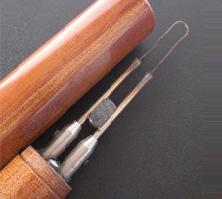
Electrocautery refers to two different methods of heating tissue to stop bleeding. Both are commonly used in male circumcision.
DC Electrocautery
"Cautery" refers to the procedure of applying heat to a wound in order to seal it. The technique has been around a long time, having been described by Hippocrates circa 400
BC.
Typically, a metallic probe of some sort is heated and then applied to the wound. The heat can come from any energy source available... the burning of gas, wood or coal, the rays of the sun concentrated by a magnifying glass or whatever. Electric power is a convenient source of heat and when this is used the combined process of heating the apparatus with electricity and then using it to cauterise is called Electrocautery.
The electric power can be DC (Direct Current) from a battery or it can be low frequency AC (Alternating Current) as comes from a domestic power socket - typically 50 or 60 cycles per second (Hertz). The electric current never comes into contact with the patient. It is merely a means of generating heat as also happens, for example, in a set of electric hair curling tongs.
In the context of circumcision, it is possible to use a device best described as an electrically heated knife. An electric current is passed through a sharp edged, loop-shaped blade made from an electrically resistive material. The sharpness cuts through the foreskin and the heat generated by the electrical resistance immediately cauterises the wound thus created. The result is no blood loss, effective sterilisation due to the heat and, in sexually immature patients, no need for sutures because the sealed wound will straight away be strong enough to withstand the tension placed on it. Adult circumcisions and very tight pre-pubertal styles would require sutures, negating the simplicity of the procedure. Thus the technique tends to be used mainly for infant and child circumcisions.
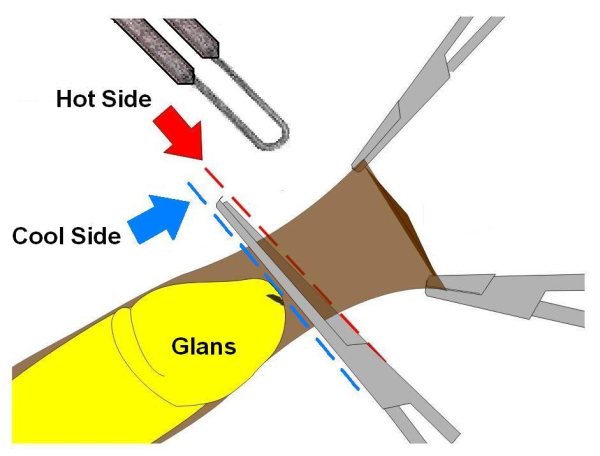
Care is needed to ensure that the heat, which is considerable, does not damage the glans. This is usually achieved by combining the use of an electrocautery device with the forceps-guided method of circumcision. The cold metallic mass of the forceps acts as a "heat sink". Thus, when placed between the heated knife and the glans, the forceps act not only as a guide for the knife but also as a barrier to the heat.
The electrocautery technique is a relatively simple method of circumcision that deserves more attention than it gets. The resulting style will of necessity be somewhat "high" because a tug-and-chop approach is always needed in order to draw the cut line clear of the glans and thus avoid heat damage. But the loose/tight parameter is adjustable at will; that just depends upon how much outer foreskin and shaft skin is drawn through the guiding forceps.
HF Electrocautery
In HF Electrocautery the electricity used is not ordinary domestic electric power, but high frequency alternating current. The frequency involved is typically around 200,000 cycles per second (200 kiloHertz).
The reason for use of high frequency is that it can pass through the body without causing electric shock. The resulting power can be used both to cut (electrosurgery) and to cauterise, even to 'spot weld' tissue if that is what is needed. There are two forms - bipolar and monopolar. Bipolar HF electrocautery has two electrodes in close proximity so that only the tissue between them is heated. Monopolar electrocautery has just one electrode used in the operation, the other is a grounding electrode applied to the patient's body, so the current passes through the body. A faulty monopolar electrocautery device was responsible for two very high-profile cases of serious penile damage in infant circumcisions in the US. While this was a freak event, monopolar cautery should be avoided when circumcising neonates, since the parts concerned are so small that they ae easily damaged.
Circumision by Electrosurgery : Video
 Content: Content:Here is a short professionally-produced video clip illustrating adult male circumcision by electrosurgery. You must have software compatible with Quick Time to view this video. A cross-platform version of Quick Time Player is available as a free download. |
Duration: 26 seconds
Copyright © 2005 O.R.R., Antwerp, Belgium |
 Disability Assistance: Disability Assistance:The associated sound track contains only the characteristic buzzing of the equipment and a few words spoken in Flemish that are not critical to understanding the visual information presented. |