| Basis of Method The foreskin is pulled forward using clamps, the extent of the traction determining the tightness of the resulting circumcision. A large pair of forceps (typically artery forceps) is then clamped across the foreskin at the place where the cut is to be made. Optionally, the smaller clamps are then removed before a scalpel is run across the top of the big forceps. Alternatively, sharp scissors can be used. This method doesn’t automatically result in a straight smooth line and there is no pre-sealing of the cut edges. Bleeding is more profuse and more stitches may be required than with other methods, especially in adults. In the days when infant circumcision was common in Britain this was the most frequently used technique, giving a relatively 'high' and (often) loose result, with the scar midway between to corona and the base of the penis. This form of cutting is very similar in principle to traditional Muslim and Jewish circumcisions. |
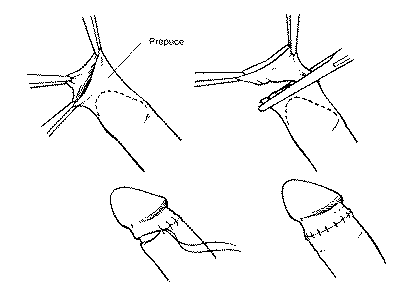 |
| Further developments This form of initial cut (but made at an angle) can be combined with removal of the inner foreskin and frenulum to give a more complete circumcision. Here is a description from a British textbook: The elongated prepuce is pulled forwards and clamped by a pair of forceps applied ... in an oblique direction forwards and downwards, after which the prepuce is cut off by the sweep of a sharp [scalpel] in front of the blades, as the glans lies safely behind the latter. The lining membrane of the remaining prepuce is next slit up the dorsal aspect of the glans almost as far as the corona and neatly trimmed, after which the remaining narrow frill or collar of mucous membrane is stitched .... to the skin margin. When the original incision is skilfully made, a pointed piece of skin remains, which can be sutured over the triangular area below the frenum. Sir William Whitla, A dictionary of treatment. London, Baillière, Tindall & Cox, 1912. 1204pp | |