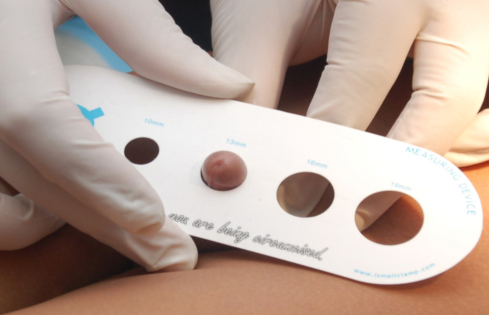
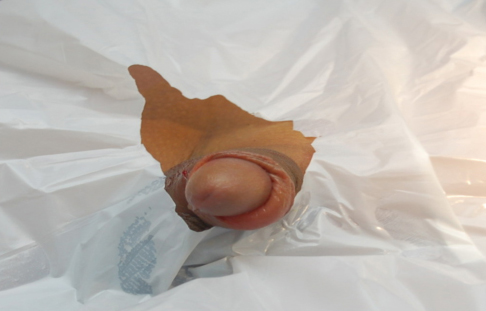
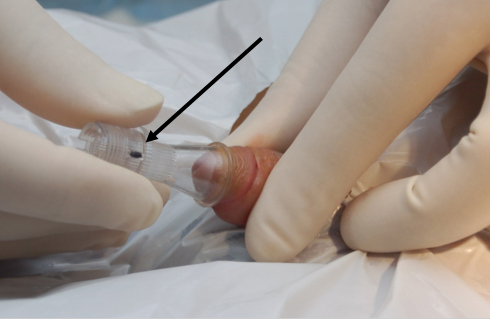
The ability to set an accurate partial grip at this stage of the process, as appropriate to the thickness of the individual patient’s skin, greatly facilitates control of the positioning of the clamp and makes the Ismail Clamp particularly well suited to very tight circumcisions. Note, though, that like most similar clamps, the clamping ring is perpendicular to the axis of the clamp and not angled to match the natural slant of the coronal rim of the glans. Thus there is a tendency for this clamp to remove relatively too little skin dorsally. This must be counteracted by the surgeon.
In common with other fit-and-wear clamps, the Ismail Clamp does not naturally remove the frenulum.
Manufacturer’s website:
http://www.ismailclamp.com/Finally, it should be noted the clamp is designed to be used by a skilled physician or other trained healthcare provider. Despite its apparent simplicity, this is not a ‘do it yourself’ device.
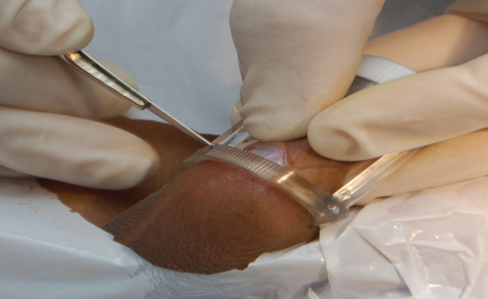
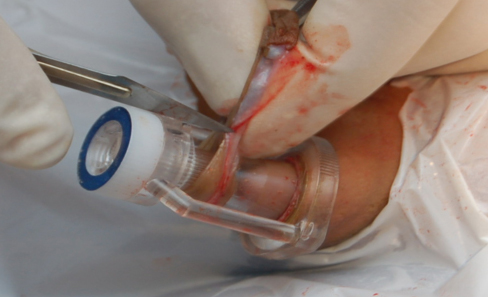
Tight circumcision using an Ismail Clamp.
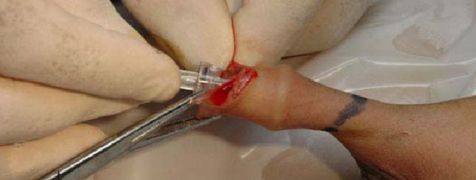 |
| 1. The black line indicates the desired position of the clamp, which is then attached so as to cover this mark. In this instance, a dorsal slit has been made to ease the insertion of the clamp beneath the foreskin. |
 |
| 2. Ventrally, the proximal face of the clamp is close to the point where the shaft skin joins the scrotum. |
 |
| 3. Dorsally, the back of the clamp is in close approximation to the abdomen. Note the quantity of tissue held between the surgeon’s left thumb and forefinger. A large proportion of the shaft skin is being removed along with the whole of the inner and outer foreskin, so as to achieve a low and (by Malaysian standards) exceptionally tight circumcision. |
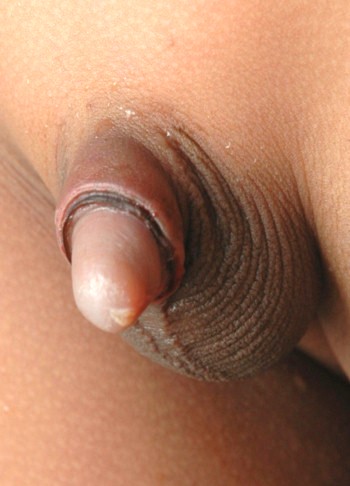 |
| 4. Note the commendably narrow band of necrotic tissue produced by this clamp and the excellent final result it achieves. |