
Ancient & Modern

|
Ancient & Modern |
|
 |
 |
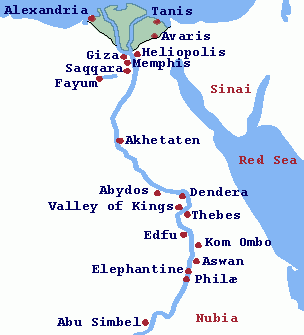
| Significant locations in Ancient Egypt Map © 2011 www.mideastweb.org |
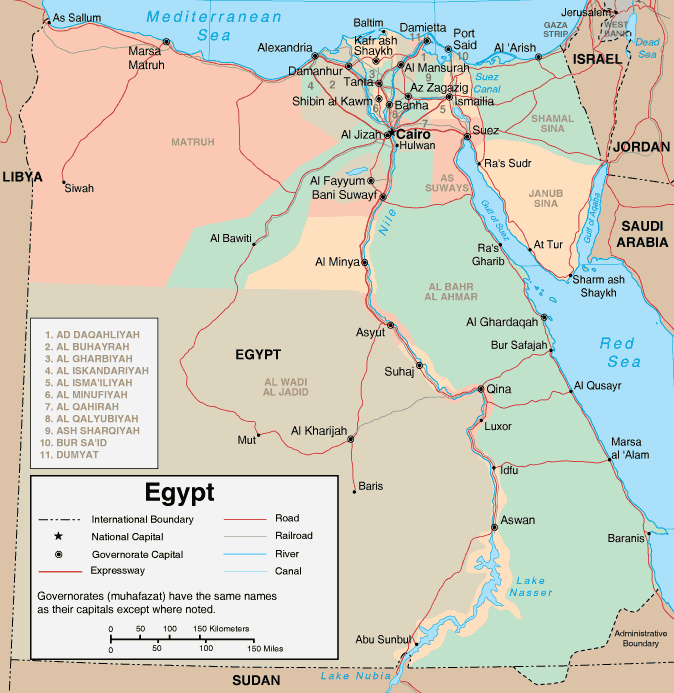
Modern Egypt (2011 borders) Map © 2011 www.map-of-egypt.org |
 Egypt in the time of the Pharaohs
Circumcision was clearly part of Egyptian life from very early on in their civilization. According to Egyptologist Wallis Budge [1], there was a very early God of Circumcision whose job was to maintain the fertility of the Nile banks. Another early Egyptian myth contended that the sun god Ra circumcised himself and from the spilt blood from his penis fell and created two other gods, Hu and Sia, sprang up and went on to create the universe. In another version the god Ahmen, creator of the universe, when he found himself alone in the universe, masturbated and out spewed mankind. Masturbation occurs frequently in Egyptian mythology, and it seems that there was no guilt attached to it, or indeed to any other sexual acts, in their religion - something which takes a bit of getting used to from a Judeo-Christian perspective.
The question of just who was circumcised in Egypt at that time has been the subject of much debate, much of which has come from those with an axe to grind. Early Egyptologists assumed that all Egyptian males were circumcised as a matter of course, with no deep religious significance. Thus Adolf Erman (Director of the Egyptian Museum, Berlin) wrote in 1886: "Circumcision was also practised from early times by the Egyptians, yet probably they did not attach so much importance to this curious custom as the Jews and Mohammedans."[2] Herodotus also, in the 5th century BC, ascribed the practice to cleaniness rather than holiness "for they put cleanliness before comeliness". [3] However he did emphasize that it was essential for the priesthood: "[Herodotus] lays great stress on their obligation to maintain a high level of ritual purity: they shaved their bodies every other day, had to be circumcised, wore only linen garments and sandals of papyrus, and washed twice a day and twice a night". [4] We know, too, that the Greek mathematician Pythagoras had to be circumcised to be allowed to study at the great temple of Alexandria. [3] Pictorial evidence suggests that shaving didn't only apply to priests, since we never see pubic hair in Egyptian art.
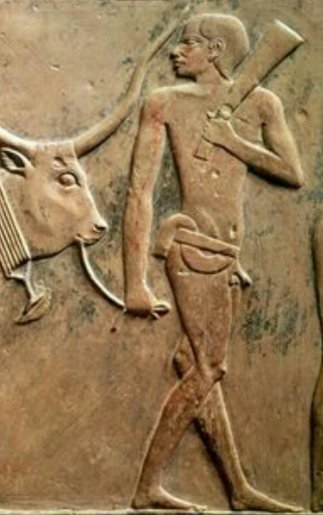
Circumcised man leading an ox (with spectacular horns), probably to slaughter since he is carrying a large weapon. Note that he has tucked his loincloth into his belt so that everyone can see his circumcised penis.
The idea that circumcision was restricted to priests seems to have no currency outside articles written from an anti-circumcision perspective. All the evidence contradicts it. All images of post-pubertal men and boys show them as circumcised, even in such un-priestly activities as carpentry (below). One issue that is commonly raised is that mummies reveal that 'some Pharaohs were not circumcised'. In fact the hard evidence is that just ONE Pharaoh, Ahomse (16th century BC) was not circumcised [5]. Possible reasons could be that he wanted to change the religious rules (as had other Pharaohs) or that he was haemophiliac. Inbreeding was common in the royal dynasties, and haemophilia would have become obvious before the age of circumcision (below). Egypt led the world in medical knowledge at that date.
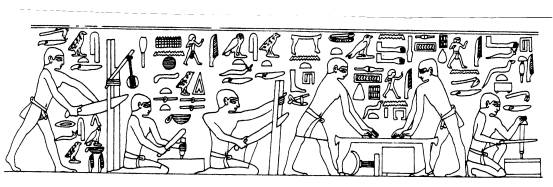 |
| This depiction of a carpentry workshop making beds and headrests, dating from the old Kingdom (c. 2686 – 2181 BC) is from Rosalie David’s book “The Egyptian Kingdoms” [6]. It is from the same site at Saqqura as our theme image of a circumcision ceremony. This is a drawing after the original relief sculpture - a rather poor photo of the original can be seen in our History and Art page. |
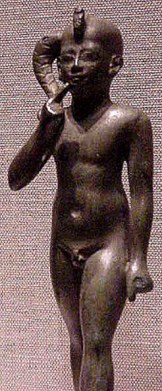
The age at which boys were circumcised was discussed by Cox & Morris [3]. It was also studied by Circlist contributor Frank Elsby. In brief, images of young boys always show them as uncircumcised, as in the sculpture (right) of the boy god Horus. X-ray images of child mummies also show them as uncircumcised, at least up to age 7. The best estimate we can make is that they were circumcised just before puberty, at age 10-12. Circumcisions for ordinary people were mass events - one account mentioned 120 boys in one ceremony - so there would probably have been a range of ages involved [3].
Horus the Child. Bronze with Silver Inlay, 664-342 BCE
Horus is the son of Isis and Osiris. He represents legal kingship as mythical successor of his father Osiris, who, in death, became Lord of the Netherworld. He was especially popular in the Late and Greco-Roman periods, often under his Hellenised name Harpocrates. Representations such as this show him as a nude boy with his finger to his mouth, and a sidelock of hair, the symbols of childhood. Here he also has a uraeus (a cobra serpent) above his forehead, symbolizing his entitlement to kingship.
Photographed at the Walters Art Museum, Baltimore, Maryland by Mary Harrsch.
Ptolemaic and Roman Egypt
From 525 BC Egypt was at war with Persia, and the balance of power shifted several times. By 332 BC the Persians were ruling as the 31st Dynasty, but then Alexander the Great arrived, and conquered. He put Macedonians and Greeks in all the major positions of power and established a new capital, modestly named Alexandria, at the site of the famous temple where Pythagoras had studied. In its Hellenised form it became the greatest centre of learning in the ancient world. Alexander himself didn't stay around long, he moved on to conquer Persia, and there was a bit of a kerfuffle over his succession until his friend Ptolemy 1st took control and started a new dynasty.
The new Greek rulers adopted Egyptian dress, and permitted the Egyptian religion to continue. They even tried to synthesize Egyptian gods with Greek ones, just as the Greeks and Romans had done (Aphrodite being identified with Venus, for example). But they remained Greek citizens and bound by Greek law, and they certainly weren't circumcised. But circumcision continued among native Egyptians (who weren't always entirely happy with their new rulers, though intermarriage naturally occurred).
The Ptolemaic dynasty came to an end with the Roman invasion in 30 BC. Cleopatra VII, the Empress, and her Roman lover, Mark Anthony, committed suicide together when their forces were defeated by Anthony's rival, Octavian. Anthony had hoped for a peaceful union of Roman and Egyptian interests but Octavian had other ideas. However, while Romans were the new overlords, and took the top positions, the administrative class remained Greek.
The apostle Mark brought Christianity to Egypt in the 1st century AD, and in spite of persecution by the Emperor Diocletian around 300 AD, Egypt became a Christian country. Their Christianity required circumcision, and formally became identified as the Coptic Church following the Council of Chalcedon in 451 AD. (The split with other churches was about the exact nature of Jesus, and had nothing to do with circumcision).
Muslim Egypt
Between 639 and 642 AD Arabs invaded Egypt, bringing Sunni Islam. That, of course, still required circumcision. Egypt remained part of the Arab Caliphate until 1517, when the Turkish Ottoman Empire conquered it - a change in masters but not in religion. Subsequent events included a spell as a British Protectorate (1914-1922) and, more recently, an Islamist revolution. Coptic churches have been targeted but the Copts seem to be standing firm. Circumcision of boys in modern Egypt is not significantly different from the routines followed in other Arab/Islamic countries. Given that Coptic Christians as well as the Muslim majority circumcise, almost all boys in Egypt will have been circumcised by mid-puberty. Most are done in the age group 5 to 11 years, a growing percentage as infants and a few during the early stages of their sexual development. One of the best-known circumcision videos on the internet was filmed in Egypt. It purports to illustrate the dissection method of circumcision but in fact it shows a dorsal slit followed by a circumferential cut. Nevertheless, a very good job done under general anaesthetic just before the onset of puberty; the patient is age 11. Probably a rather expensive option for many ordinary Egyptians.
Wikipedia, of course.
Contributor Frank Elsby, who provided much of the material on this page.
Mary Harrsch and Walters Art Museum, Baltimore, Maryland
References
1. E A Wallis Budge, The Gods of the Egyptians, Vol.1. Dover Publications, 1969, 608pp.
2. Adolf Erman, Life in Ancient Egypt. First published in 1886. English Edition (1894) edited by Helen Mary Tirard. Republished by Dover Publications Inc.: Mineola NY, 1971.
3. Guy Cox & Brian J. Morris, 2012. Why Circumcision: From Prehistory to the Twenty-First Century. Chapter 21 in: D.A. Bolnick et al. (eds.), Surgical Guide to Circumcision, Springer-Verlag London. 243-259
4, Alan B. Lloyd, Ancient Egypt, a Social History. Chapter 4 - The Late Period, 664‒323 BC. Cambridge University Press, 1983.
5. Janes E Harris and Kent R Weeks. X-raying the Pharaohs. Scribners, N.Y. 1973
6. Rosalie David, The Egyptian Kingdoms, Elsevier, Lausanne, 1975.