 |
 |
||
What happened to Yugoslavia....?
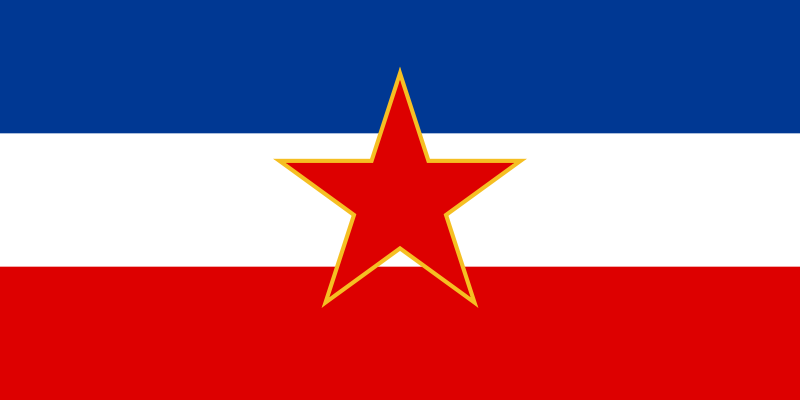
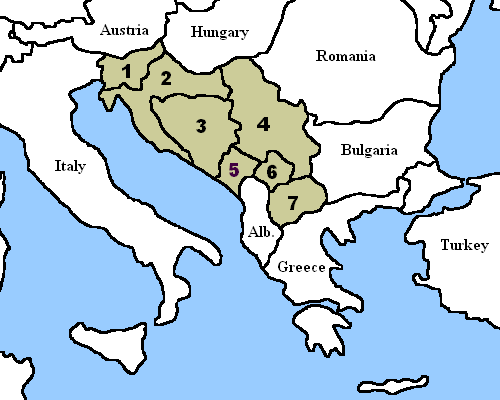
Some older readers probably still think of the Balkan region as synonymous with Yugoslavia - a nominally united communist country bordering the Adriatic Sea and stretching from Italy to Albania. But the country properly called the Socialist Federal Republic of Yugoslavia is no more! It disintegrated into separate states - currently seven in number. The divisions are largely on religious grounds - Catholic Christianity, Orthodox Christianity and Islam.
Fragments of the former Socialist Federal Republic of Yugoslavia (July 2013) |
|
 |
|
Dates of fragmentation
| Fragment | Date of Separation |
|---|---|
| Slovenia | 25.Jun.1991 |
| Former Yugoslav Republic of Macedonia | 08.Sep.1991 |
| Croatia | 08.Oct.1991 |
| Bosnia-Herzegovina | 01.Mar.1992 |
| Kosovo | 10.Jun.1999 (Disputed) |
| Montenegro | 03.Jun.2006 |
| Serbia (including Vojvodina) | The remnant |
There is a certain irony in regarding Serbia as the remnant of Tito’s state, given that at one time Serbia was the seat of opposition to communism in Yugoslavia.
During the period of occupation of Yugoslavia by the Wehrmacht (1943-44), there were two rival guerilla armies fighting not only against the Germans but also at times against each other. On the one hand, the communist Tito and his “Partisans”, with a power base in Croatia. On the other hand, the supporters of the Yugoslav Government in Exile in London, loyal to King Peter II, led by Draža Mihailović, known as “Chetniks” and strongest in Serbia.
For reasons that for decades remained secret but have now been documented in the TV Series Secret War (Series 1, Episode 13 ‒ The Aristocrat and the Balkan Communists), Winston Churchill allied with the Partisans rather than with the Chetniks, first sending British special forces officer Fitzroy MacLean into occupied Yugoslavia to make contact with Tito and later sending his own son, Randolph Churchill, behind German lines as an envoy. It was an improbable alliance, in part a consequence of disinformation about the relative fighting prowess of the Partisans and Chetniks planted within the British ‘Special Operations Executive’ (SOE) by James Klugmann, a communist spy working in SOE’s Cairo office who later became a member of the executive committee of the British Communist Party and editor of Marxism Today.
The consequences of the British having exclusively backed Tito with both Special Forces on the ground and air support by the RAF reverberate to this day. Had that support instead been given to the Chetniks, Yugoslavia might not have become communist after World War Two and that in turn would have led to a very different situation in the Balkans today.
Acknowledgements
The following resources were used in the preparation of this web page:
Wikipedia.
Map courtesy of www.youreuropemap.com.

Copyright © 1992 -2017, All Rights Reserved CIRCLIST.