The Gomco® Circumcision Clamp
Originally made by the Gomco Surgical Manufacturing Corporation of Buffalo NY, USA, this design of circumcision clamp remains in common use and has seen off many later variants. The precise date of product launch is uncertain, but the US Patent and Trademark Office has on file an advertisement published 25.April.1935. The theoretical principle of operation relies on the work of H.S. Yellen, in particular on a paper “Bloodless Circumcision of the Newborn” he read to the Buffalo Academy of Medicine on 23.Jan.1935. Realisation of the first practical design to implement the general concept is frequently attributed to A.A. Goldstein, but there is some suggestion that the
Winkelmann Clamp may have pre-dated the Gomco design. This would account for the fact that the patent in Goldstein’s name is a Design Patent (D119180) and not a Utility Patent. Recent research has uncovered a 1914 paper in the
Buffalo Medical Journal of 1914 by a Dr Joseph S Lewis, of a device with similar operation to the early Gomco clamp is described and illustrated. In this article, the author states he knows of no similar device, and describes having the ones illustrated made by a toolmaker, in sizes between 3/4 inch (19mm) and 1 1/2 inches (38mm). Whoever the designer, it is reasonable to assume the device is over 100 years old, and probably originated with physicians in the Buffalo NY area.
Although the original patent has long expired the name Gomco is still a Registered Trade Mark, currently the intellectual property of Allied Healthcare Products. Thus, whilst look-alike devices can now be produced without infringement of design rights, the name Gomco can only lawfully be used to describe the commercial product of the Trademark holder or their licencee.
The Gomco circumcision clamp comes in a wide variety of sizes for use on infants, boys and men of all ages and sizes. By careful adjustment it can be used to achieve a variety of styles of circumcision. It is especially suited to performing tight circumcisions pre-puberty; because the bell has a closed end there is no danger of it slipping past the glans as can happen with a
Plastibell. However, it is possible for the coronal rim of the glans to be trapped in the clamp. Extreme care is needed to avoid this possibility. Using a bell one size too large prevents this risk and gives a 'higher' circ, and it seems that some doctors do take this approach.
The clamp naturally produces a relatively 'low' style, especially compared with the forceps-guided technique. However it also has the ability to deliver very tight circumcisions, much tighter than can be achieved with a Plastibell.
Description of the device
The clamp is made up of 4 parts: a plate, a stud (bell), an arm (yoke), and a nut (to tighten the clamp). As illustrated below (left), the nut and the yoke can be common to several sizes. Only the bell and the plate need to be selected to fit the glans of the patient. Careful pairing of these is required. A USFDA Caution exists in respect of worn or incorrectly matched components.
 |
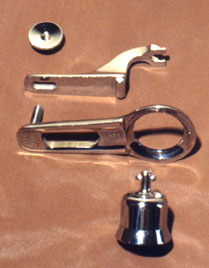 |
| A set of Gomco Clamps, sizes 13mm, 16mm and 21mm |
Parts in adult size |
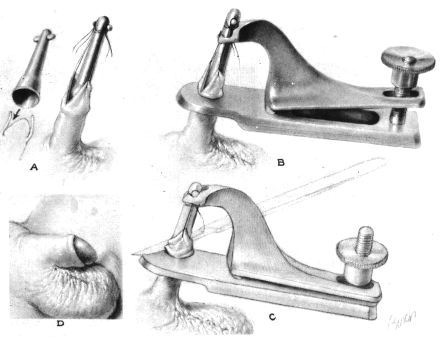
The bell is introduced into the preputial cavity (over the glans and under the foreskin) and the prepuce is drawn over it. The plate is then placed over the bell so that the prepuce is sandwiched between them. The arm is fitted into its proper place and when the nut is screwed on tightly, it exerts a crushing force on the prepuce at the junction of the bell and plate. The clamp is left on for 5 minutes to achieve hemostasis and the prepuce is then excised with a scalpel. Due to the metallic construction of the clamp, electrosurgical techniques cannot be used.
Note: This device should not be used to do a self-circumcision. Circumcision should always be performed by a trained and skilled healthcare provider.
Illustration of procedure
 |
 |
| Artist’s impression : Gomco circumcision of a young boy |
 Wound closure in adults and older boys : Sutures or glue?
In infants, the crushing action of the Gomco clamp is normally sufficient to bring about wound closure without further intervention. However, in older children and adults some form of reinforcement is necessary in order to prevent the wound edges from separating during erections. Traditionally this is done by suturing, normally using absorbable suture material. This complicates matters, increasing both the skill requirements and the duration of the whole procedure.
Doctors in Beira, Mozambique, are using the Gomco clamp followed by
Dermabond® to seal the wound. Such cyanoacrylate tissue adhesives (essentially specially-formulated super glues) are used extensively in medicine and have been shown to provide excellent results in circumcisions. The objective is to de-skill the surgery such that Gomco circumcisions can, in the context of anti-HIV mass circumcision campaigns, be performed by general medical practitioners and surgical assistants. This allows circumcisions to be done under local anesthesia using standard instruments in primary care clinics, thus allowing fully trained surgeons to attend to other, more complex duties.
The procedure is illustrated here:
| Gomco + Wound Glue as being used in Mozambique (2011). |

1. Assembly of the Gomco Clamp |

2. Gomco in place |

3. Removing the foreskin |

4. Foreskin cut |

5. Gomco clamp removed (1) |
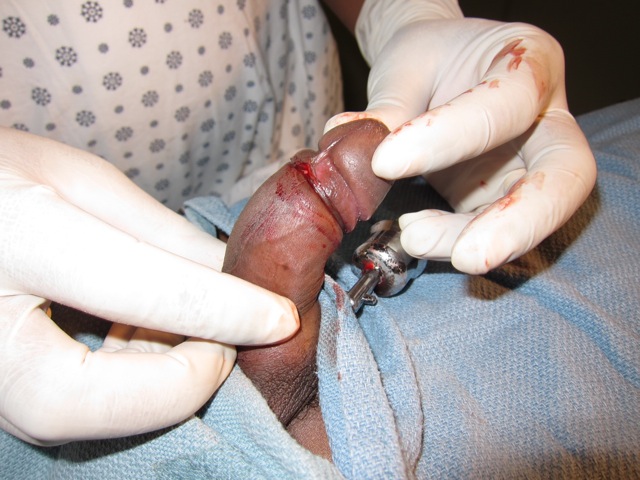
6. Gomco clamp removed (2) |

7. Applying glue |
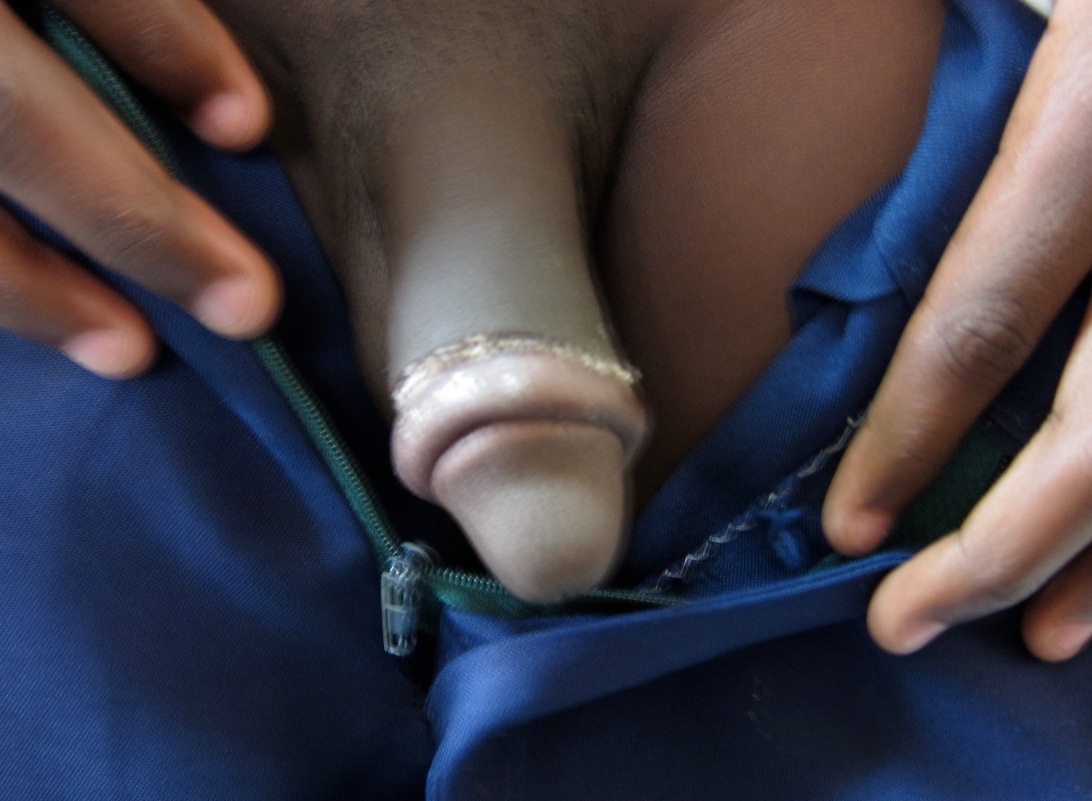
8. One week after surgery (Dorsal) |

9. One week after surgery (Ventral) |

10. Three weeks after surgery |
  Watch a video of the whole procedure on YouTube. Watch a video of the whole procedure on YouTube.
A full report of this method is expected to be published shortly in Tropical Doctor. |
Device Evolution Added November 2015 by MG
From the earliest design of its type, to the current, the Gomco clamp has undergone a number of design changes. The initial design was somewhat similar to what became the Winkelmann Clamp, with a threaded bell being pulled upwards by the turning of a wing nut. In contrast to the Winkelmann design, the cutting point was at the bottom of a "valley" in the tool. This design carried over to initial versions of the Gomco clamp, but allows only a very small contact point for a surgical scalpel, which may lead to a poor cosmetic result. At some point, the design was changed to the one presented to market today, with a flush cutting surface. In the late 1990s, a production date was added to the arm of the clamp, to help manage equipment lifecycle and to retire tools that were old and at risk of damage.

Initial design of Lewis's "circumcisor" tool
|

Early Gomco clamp
|

Evolution to flat plate
|

Arm showing production date
|
Third Party Versions
As the initial design has been without patent protection for many years, a number of third party versions of similar clamps have been produced. The most innovative of these is the Centurion Circlamp. The Circlamp comes in two versions - one with a universal plate with both stud and cutting plate inserts for each size, and a regular fixed size version. Both versions feature an innovative circular retention mechanism at the top of the stud, vs the bar in the classic lever design. The circular mechanism allows the stud to be lifted without needing to align the plate with the bar. This prevents potential malapposition of the inner and outer foreskin being caused by the plate twisting one layer of skin

Centurion Circlamp
|

Little Trimmer - Australian clone from 1970s
|
Related reading
The Gomco Circumcision: Common Problems and Solutions
http://www.aafp.org/afp/980915ap/peleg.html
Sales outlet of the current Trademark owner:
Known manufacturers of look-alike products:
Other manufacturers and wholesale distributors wishing to have their names added to this list are invited to
contact the Editor.
Incremental improvements
A number of attempts have been made to introduce incremental improvements to the original Gomco design. Notable are the
Circumstat and Baumgarten’s Modification (United States Patent number 3874389, which the inventor assigned to the Gomco Surgical Manufacturing Corporation in 1974).
Acknowledgements
The following addditional resources were used in the preparation of this web page:
Copyright © 1992 - 2015, All Rights Reserved CIRCLIST.