|
|
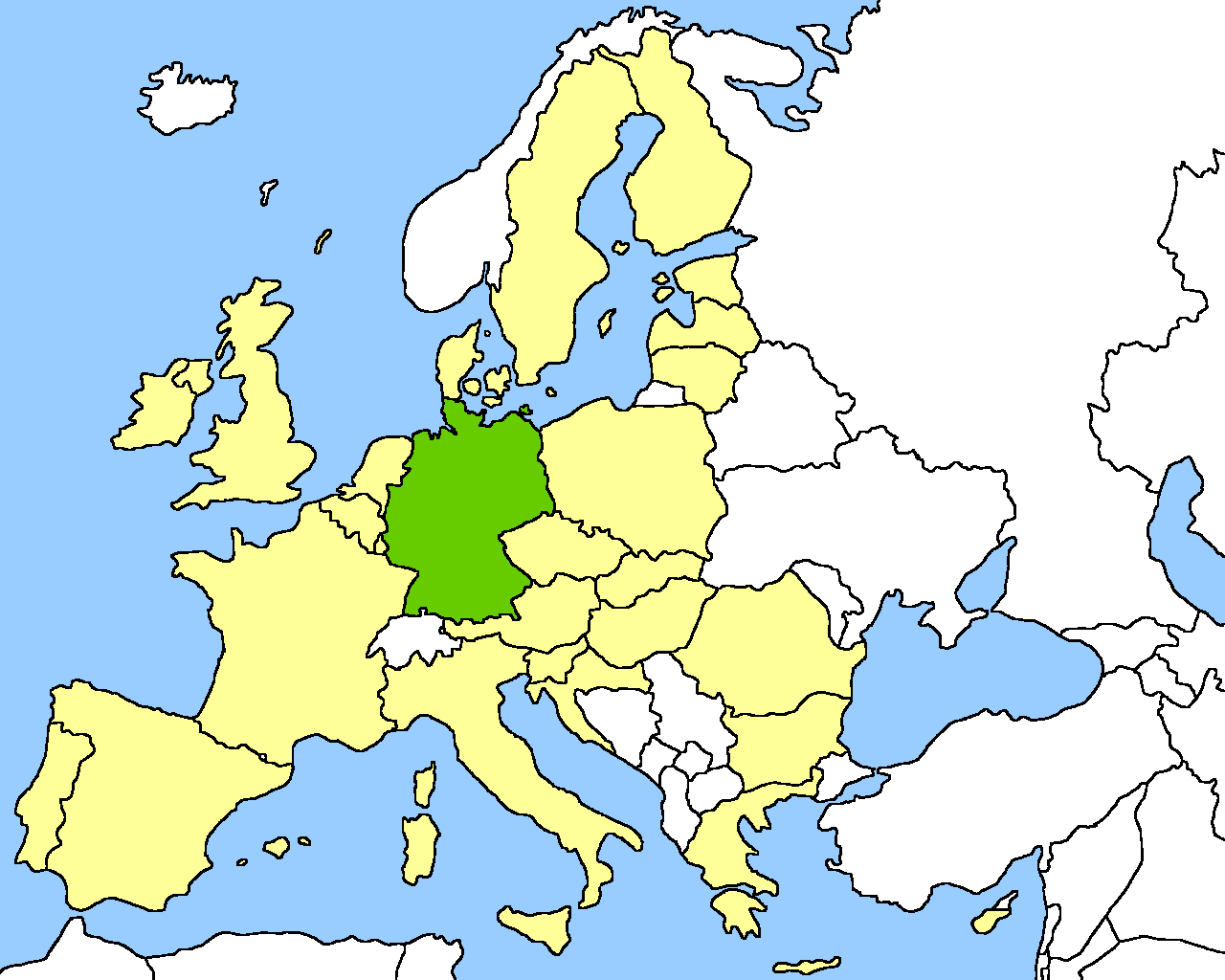
Germany today sits pretty much at the geographical centre of the European Union, one of several factors leading to the country’s dominant economic position within the trading bloc.
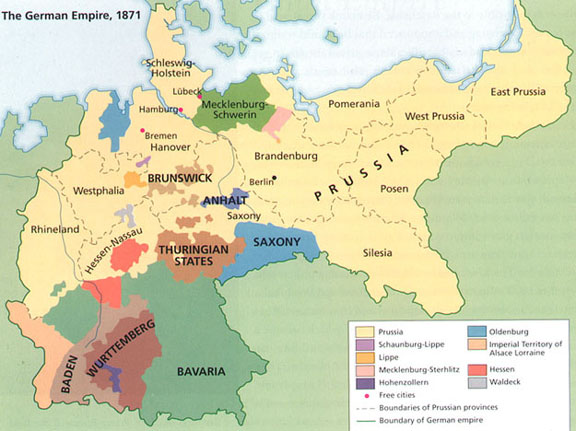
Prior to the formation of the German Empire in 1871, Germany did not exist as a unified country. It was a loose federation of states with differing forms of government, united mainly by a common culture, a common language and established trade routes dating back to the time of the Hanseatic League. The German Empire was in large part a realisation of the concept of Kleindeutsche Lösung (“the Lesser German solution”), one of two rival nineteenth century proposals for uniting the german-speaking peoples into a single nation state with Prussia as its focal point.
After the First World War huge territorial losses were imposed by the Treaty of Versailles (1919), reducing Germany to the area coloured brown on the map dated 1933‒1938 below. From 1919 to 1933 this territory was administered by a parliamentary republican government called the Weimar Republic. Following the disbanding of the Inter-Allied Rhineland High Commission in 1930, it also administered the Rhineland (Rheinland in German), which was a demilitarised zone until Third Reich troops occupied it in 1936 and re-established full sovereignty. Also during the 1930s under Adolf Hitler, some other territorial expansions took place. The Saarland was re-incorporated into Germany by a plebicite in 1935 and in 1938 Austria unified with the Third Reich through a process called the Anschluss (Union). Also in 1938, Germany annexed the Sudetenland, the German-speaking parts of what was then Czechoslovakia.
Following Germany’s defeat in the Second World War much of Silesia, in the country's east, was ceded to Poland. The remaining country was divided into zones administered by Russia, the United States, Britain and France. In 1949 the Soviet Zone became a nominally independent state within the Soviet bloc called the “DDR” Deutsche Demokratische Republik (German Democratic Republic or East Germany). In the same year the US, British and French Zones became the Bundesrepublik Deutschland (Federal Republic of Germany or ‘West Germany’). Separate divisions existed in the former capital, Berlin, which was surrounded by East Germany and connected to West Germany by the “Berlin Corridor”. This situation continued until the Soviet Union’s economic collapse in the late 1980s. That destabilised the DDR government and with it, the division of Germany epitomised by the infamous Berlin Wall. The frontier was opened and unification followed almost immediately, formalised on 3 October 1990. Later the same decade, much of the former central government of West Germany relocated from Bonn to Berlin.
The land area of the reunited Germany is 348,672 km², a little less than two-thirds of the country’s territory as it was in 1910.
 |
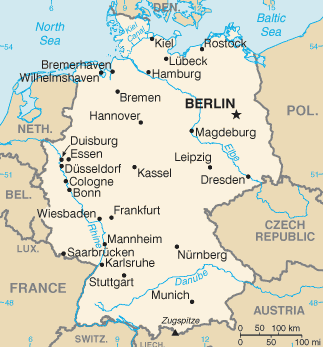 |
| Germany - Location within the European Union | Germany - Borders since reunification |
 |
 |
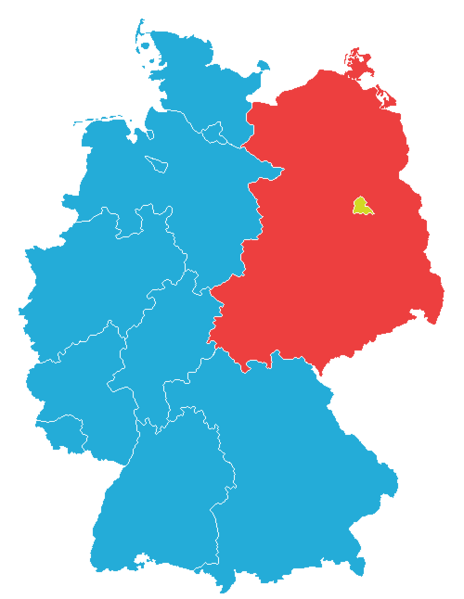 |
| The borders of Germany during recent history. CLICK TO ENLARGE. Left to right: 1871‒1914, 1919‒1938, 1945‒1990 | ||
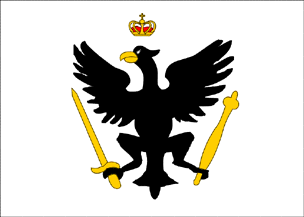 Circumcision in Prussia before 1871.
Germany was a pioneer of the nudist movement, meaning social, non-sexual nudity and nude bathing. This movement had its origins in the mid 18th century. It probably served to discourage circumcision among Christians, both because it made a man obviously different, and because the inspiration for the movement was ancient Greece, where foreskins ruled. Such circumcision as did take place prior to the formation of the German Empire would have been amongst religious Jews (then numerous) or as a treatment for phimosis.
 Circumcision in the German Empire and the Weimar Republic.
Nudism flourished after the formation of the German Empire. The world's first nudist club (Freikörperkultur or FKK) was founded in 1898 and many more clubs followed thereafter. Nudity, open air and health were key issues. The idea had spread to France and the UK, but both looked to Germany as the pioneer. Conformity was important in Germany, whereas individuality was important in England. Hence in Britain the movement probably helped the spread of circumcision whereas in Germany it hindered it. Germany had the world's first official nudist beach, on the island of Sylt, in 1920 and it became a tourist magnet for health enthusiasts (and still is).
An unresolved issue relating to circumcision at this time concerns the Winkelmann Clamp. To date, no patent for this device has been traced, making it difficult to identify its inventor with any degree of certainty. It has been provisionally credited to the German urological surgeon Karl Winkelmann (1863‒1925) after whom the Winkelmann‒Jaboulay operation for hydrocele is named. If this is correct then the whole history of the Gomco Clamp needs to be re-written, because of the clear implication that the ‘Bell Clamp’ concept did not originate with Yellen and Goldstein. (Recent research has shown that this is indeed the case - see our Instruments and Techniques page.) It also suggests that the medical profession in Germany was beginning to consider the health benefits of circumcision just as in England and the US at the time.
 Circumcision in the Third Reich (1933 to 1945).
The persecution of Jews, gypsies and homosexuals during the Third Reich is well documented. Not being circumcised may have been a distinct advantage at this time! (See the movie 'Europa Europa'). However it is widely reported that because of the conditions under which they worked, many soldiers in Rommel's desert army had to be circumcised.
 Circumcision in the Deutsche Demokratische Republik (East Germany, 1945 to 1990).
Persistent rumours have circulated about state-promoted circumcision in East Germany. The facts are more mundane. Otto Dietz, a doctor in the dermatology division of the Volkspolizei (Secret Police) hospitals, was clearly an enthusiast for circumcision. He was not the medical director - his superior, as given in his first paper on the topic [1] was Dr. med Maiss, though whether Maiss was Chief Medical Officer of the entire Volkspolizei hospitals, or just of dermatology, is not clear. This 1954 paper presents a new circumcision device and also makes it clear that at that time circumcision was only performed for phimosis and other related conditions. In 1957 Dietz published a joint paper [2], with the American Ellsworth C. Dougherty, of the Kaiser Permanente Hospital in Oakland, California. Again contrary to rumours, there is no indication that the two ever met, this seems to have been just a review conducted by correspondence. (Dougherty, later of UC Davis, was a very eminent developmental biologist and not a specialist on circumcision). This paper, published in a medical newspaper rather than a specialist journal, strongly urged the adoption of prophylactic infant circumcision in Germany. Dietz much later published a review of 2,800 circumcisions carried out in his hospital[3]. He recommended the Gomco clamp for neonatal and child circumcisions and his own 'Scherenlyra' (a Mogen clamp and curved scissors combined in one instrument) for adult operations.
Whatever, it's clear that the East German health authorities were not sufficiently impressed to introduce routine circumcision into their hospitals. In a communist country you do what you are told and if circumcision became the rule all boys would be circumcised - which they weren't.
Allegations have been made that young female athletes aspiring to join the country’s olympic team underwent clitoridectomy in order to ‘reduce sexual distractions’ and conceal the use of male hormones and anabolic agents as performance-enhancing drugs. It is difficult to unravel truth from black propaganda here; more evidence is needed.
Circumcision in the Bundesrepublik Deutschland (West Germany, 1945 to 1990).
 For ten years after the war, there was a strong US military presence in the south of West Germany, encompassing almost all of present-day Bavaria and Hesse, the north-east part of Baden-Württemberg including both Stuttgart and Karlsruhe, along with parts of the Bremen area in the north and the American Sector of West Berlin. Many of these American soldiers found German girlfriends and, in due course, wives. Any babies born in US military hospitals in Germany, or back home in the States, were usually circumcised before discharge. A correspondent to the old Circlist group described how she and her American husband took their baby son to see his German grandparents. At nappy (diaper) change time came the horrified cry from Grandma "wie die Juden!" ("like the Jews"!). The young mother was able to pacify her, explaining the health and hygiene advantages, and that it was done to all American boys. But the problem is understandable - the grandmother had lived through a time when being circumcised was a death sentence. And this is the major reason why circumcision has been slow to catch on in Germany.
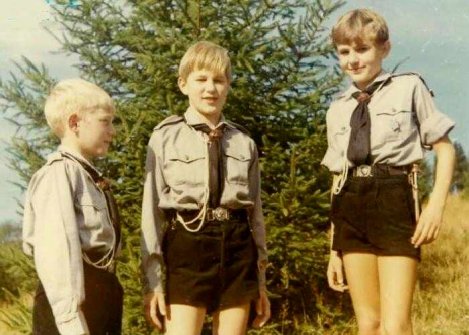
German Boy Scouts in the 1960s
Not that there was any lack of trying. According to Frederick Hodges, the American anti-circumcision campaigner and bar room pianist, the Gomco company established a distribution centre in Ulm in 1957, and set out to promote their product (a perfectly natural thing to do). Trials of Gomco circumcision took place in Darmstadt and Giessen, the latter a very American-influenced city [4]. This paper was clearly looking at making infant circumcision routine, but in the end reads more like an advert for the Gomco Clamp. A second paper has not yet been sighted [5]. However, for reasons already explained, circumcision failed to become popular - they were ahead of their time. Memories of the 3rd Reich were still too raw.
Gastarbeiter is German for ‘guest worker’ (or guest workers ‒ the plural is the same as the singular). It refers to migrant workers who had moved to Germany mainly in the 1960s and 70s, seeking work as part of a formal guest worker programme (Gastarbeiterprogramm).
With a booming economy short of unskilled workers, in 1961 West Germany negotiated a migration agreement with Turkey that brought in hundreds of thousands of temporary guest workers. The Gastarbeiter were young men who were paid full-scale wages and benefits, but were expected to return home after a few years.
The original migration agreement with Turkey ended in 1973 but few workers returned because of a shortage of good jobs in Turkey. Instead they brought in wives and family members and settled in ethnic enclaves. By 2010 there were about 4 million Muslim people of Turkish descent in Germany. Turks in Germany are concentrated predominantly in urban centers; mostly in the former West Germany. They have become integrated into German life much more than Muslim immigrants in the UK.
The reunited Germany (1990 to present).
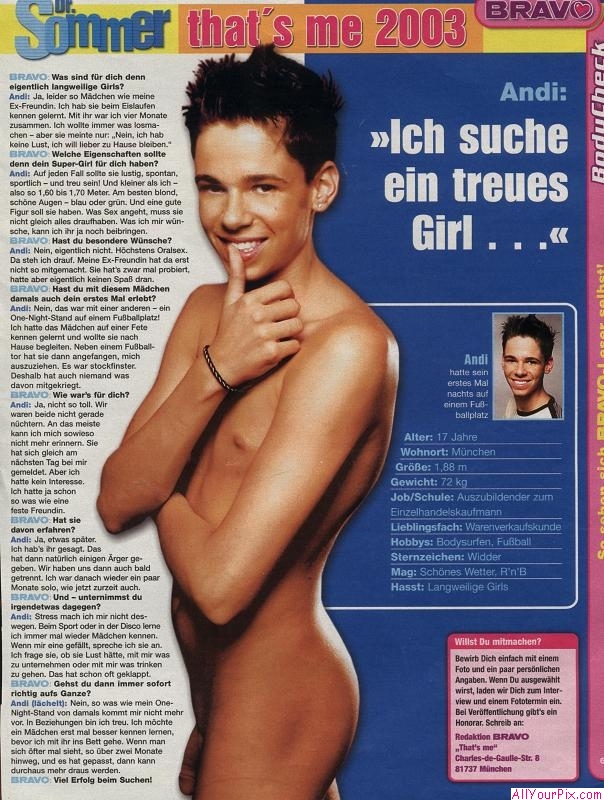 26 years on from reunification, Germay is booming and very multicultural, as this image from the German teen magazine Bravo shows. (Click the image to see it full size). The teenager is probably Muslim since he is circumcised and shaves his pubic hair, but he is still just 'Andi', a German boy searching for 'a faithful girl', to the magazine's readers. There is no mention of religion or ethnicity.
The FKK (nudism) tradition remains hugely popular in Germany, with FKK facilities available even in quite small towns, typically offering access to a lake or river and a grassy area where one can sunbathe, as well as refreshments. During the long German winter, people migrate to their local saunas. In Germany and some other European countries, normal practice is “wear” only a towel with some saunas offering a few women-only sessions. Thus, as with FKK, “all is revealed” among families, friends, schoolmates and work colleagues.
Reports from these are that circumcision is very common, as is sporting a retracted foreskin. Unsurprisingly, there is often some confusion between the two. Many of these will be later circumcisions in adolescence for phimosis. Our Preferences and Experiences page reports some such, as well as stories from Germans who chose circumcision as adults. There are reports that many teens, seeing the advantages their circumcised friends have, are opting for circumcision of their own accord. There are even stories of German wives or girlfriends demanding their partner be circumcised. But infant circumcision is becoming more and more popular as old prejudices disappear. Recent estimates put the infant circumcision rate among ethnic Germans at about 15%.
It seems the rate is still increasing. The German "Natural Health" website Heilpraxis ran an article in October 2013 "Mehr Beschneidungen in Deutschland bei Jungen", "More circumcision of boys in Germany". Some quotes for those who don't read German. "The number of outpatient circumcisions of boys under five has risen by a third in the past five years. There have been reports of billing fraud. The newspaper Frankfurter Allgemeine Sonntagszeitung reports that the National Association of Statutory Health Insurance Physicians states that the number of outpatient circumcisions of boys under five years has increased by 34% from 2008 to 2011. Similarly, between the years 2006 to 2011, the number of foreskin operations covered by the health insurance company AOK increased by 30% even though during this period the number of insured boys decreased by 5%. Although a medical indication would rarely be present, the costs are covered by health insurance. ...... Circumcisions are a profitable business for pediatric surgeons. According to their own information they carry out 21,000 circumcisions annually. Therefore, at 300 Euros per procedure they earn at least six million euros from circumcision."
In 2012, a major upheaval took place regarding the legality of circumcision in Germany. In brief, Muslim parents in Köln (Cologne) had their son circumcised and a major haemorrhage a few days later led to the boy being admitted to hospital. The parents alleged malpractice by the doctor, and the case ended up in court. The court exonerated the doctor but declared that religious circumcision was illegal. The ruling by the district court of Cologne said circumcision "for the purpose of religious upbringing constitutes a violation of physical integrity". It added: "The child's body is permanently and irreparably changed by the circumcision. This change conflicts with the child's interest of later being able to make his own decision on his religious affiliation." Source: BBC News July 13th, 2012. (The latter part is puzzling since while some religions require circumcision none, except Sikhism, prohibit it.)
The uproar that followed was all too predictable. (Heilpraxis, in the article quoted above, sourly suggested that some of the outcry came from pediatric surgeons seeing their incomes dwindle.) Almost immediately Chancellor Angela Merkel announced that circumcision would not be banned, but did not explain what she would do about it. On the 21st July Germany's parliament (the Bundestag) passed a tri-partisan resolution calling for the right to circumcise to be protected, and demanding a draft law be presented by autumn. This duly happened, and on 13th December the Bundestag passed a bill confirming the legality of circumcision done with the consent of both parents. See the Religion Clause blogspot for more details.
It seems that among the younger generation of German boys circumcision is already extremely common. A correspondent to the German teen website Pointer asked other boys how many of their class and sports team were circumcised. That conversation is no longer on Pointer but you can read a complete English translation here. The blog ran from late 2011 to January 2015 (by which time it was getting off-topic) and it makes very interesting reading. Circumcision rates ranged from below 10% to over 50%, and it really looks like there is an overall rate of around 30%. This is an enormous attitude shift in 60 years.
Reader Jan sent a link to another German teen website Jungsfragen ("Boys' Issues") which presents an impressive list of statistics about teen boys' sex lives and penises. At the time of writing (November 2016) 34,307 reports had been tallied with 78% uncircumcised, 19% circumcised and 3% "stretched" (uncovered by medical dilation rather than cutting). You can see the individual reports by clicking on the "Penisliste" tab - this includes whether foreskin is long or short (long seems more common) as well as age and reason for circumcision, but these are not tabulated in the statistics. Medical circs seem far more common than religious ones, suggesting that the Muslim population is under-represented. The site covers Austria and Switzerland as well as Germany.
Now (January 2016) Germany is welcoming refugees from the Syrian and Iraqi conflicts to provide labour for its still flourishing industrial sector, and most of these new arrivals will also be circumcised. As more and more inter-marriages take place we may well see an even greater extent of infant and boyhood circumcisions in Germany.
This doesn't please everyone, and the fringe AfD party (Alternative für Deutschland), which is anti Euro and anti immigration is trading on that. They are also opposed to kosher and halal food being sold, and of course to circumcision. Here is their (rather hilarious) take on circumcision:
"AfD against the circumcision of boys
Circumcision of young boys is in any case superfluous. Thus when parents speak to
their boys at the age of 12 to 13 saying 'one pulls it high up', the foreskin then
usually is retracted for a lifetime and the difference from a Muslim or a Jew
becomes minimal. Added to which the small benefit that the glans becomes less
sensitive, something that in due course gives pleasure to the ladies, as I faintly
remember myself. In any case, masturbation is easier when the foreskin is present
but retracted and has somewhat shrunk. So I certainly don't scoff but rather take
seriously the new 'Online Sex Codex for Refugees' from the Ministry of Health, in
multiple languages and with illustrations, which explicitly discusses 'Masturbation
with a circumcised penis'." translation by Tom
You can read the original German here.
Dutch reader Arend has traced down the document referred to, which is not called a "Sex Codex for Refugees"! It is Zanzu, "My body in words and pictures", a website created jointly by German and Flemish health authorities with the collaboration of WHO. It is multilingual, in the major European languages as well as Turkish and Arabic, so it is obviously aimed at the entire population, not just refugees. We've linked the English version. The page on 'self-pleasuring' suggests, as one might expect, pumping the skin if you are uncircumcised or using a lubricant if you are circumcised.
As to the parents' advice to 12-year-olds, nobody has yet reported getting such advice. Many German (and British) men wear their foreskins retracted, either because they are naturally like that or because they find it more comfortable and convenient. Many Asian boys do, as described, retract their foreskins once and forever just before puberty but they would never, ever discuss that part of the body with a parent. But maybe it will become an official AfD recommendation to parents  .
.
As of 27th April 2016, it appears that AfD, in advance of its Annual Convention this weekend, has abandoned its opposition to circumcision. However, it remains opposed to all other Muslim and Jewish religious practices, including halal and kosher food. Click here for more details.
Most of these fringe far-right parties flicker for a while and then go out (eg One Nation in Australia) and AfD has already split in half once in its short lifetime. In any case the growth of circumcision in present-day Germany is so great that its momentum is probably unstoppable. And Hooray to that!
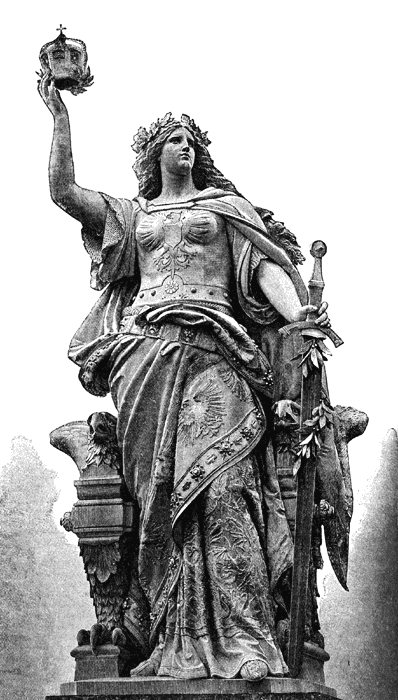
Photograph of the Niederwald National Monument courtesy of Skadi Forum. Historical information about Germany from Wikipedia. Maps courtesy of www.youreuropemap.com, the US Central Intelligence Agency, Scrapbookpages.com, Alexander Ganse and Wikimedia. Additional information from Alex Madden, Tom, Arend and Jan.
1. Dietz O., 1954 Beitrag zur Technik der Beschneidung. (Study of a technique for circumcision.) Hautarzt 4:172-174 Summary and synopsis
2. Dietz O., Dougherty EC., 1957 Vergleichende Studie zur Frage der Beschneidung in Deutschland und in den Vereinigten Staaten. [Comparative study on the rates of circumcision in Germany and the United States] Deutsche Gesundheitswesen 12, 193–196 Summary and synopsis
3. Dietz O., 1970 Erfahrungsbericht über 2800 Zirkumzisionen (eine sexualhygienische Betrachtung). [Experience report on 2800 circumcisions (a sexual hygienic observation)]. Dermatologische Monatsschrift 156(12): 1029-1034 Summary (English) Full paper (German)
4. Hofmeister KB, 1959 Über erste Erfahrungen mit der routinemäßigen Beschneidung des Neugeborenen in Deutschland und Gedanken zur Krebsprophylaxe [First experiences with routine circumcision of newborn infants in Germany and thoughts on cancer prevention] Geburtshilfe Frauenheilkd. 19(1):20-31. Summary and synopsis
5. Kelâmi A, 1966 Die sogenante Gomectomie [The so-called gomcotomy as the method of choice for circumcision] Chirurg. 37(11), 512-513
We thank Dutch correspondent Arend for locating three of these papers and German reader De Besch for locating Dietz 1970. This has given us a much better understanding of the post-war German situation. Any reader with further information please contact us.